
Introduction
The tax system has a significant part to play in a nation’s growth. The government spend the taxes collected on the development of the nation. The infrastructure, healthcare, roadways etc are all developed through the money received through tax. The launch of Goods and Service Tax (GST) has played an important role in simplifying the indirect tax structure. Many countries have benefitted a lot from this. It’s very necessary to understand the GST summary for individuals as well as businesses. The GST summary gives an overview of tax obligations and credits received. In this article, we will study how GST summaries can be accessed. We will also understand why is it so important and different ways of accessing GST summary. Example of GST Summary :-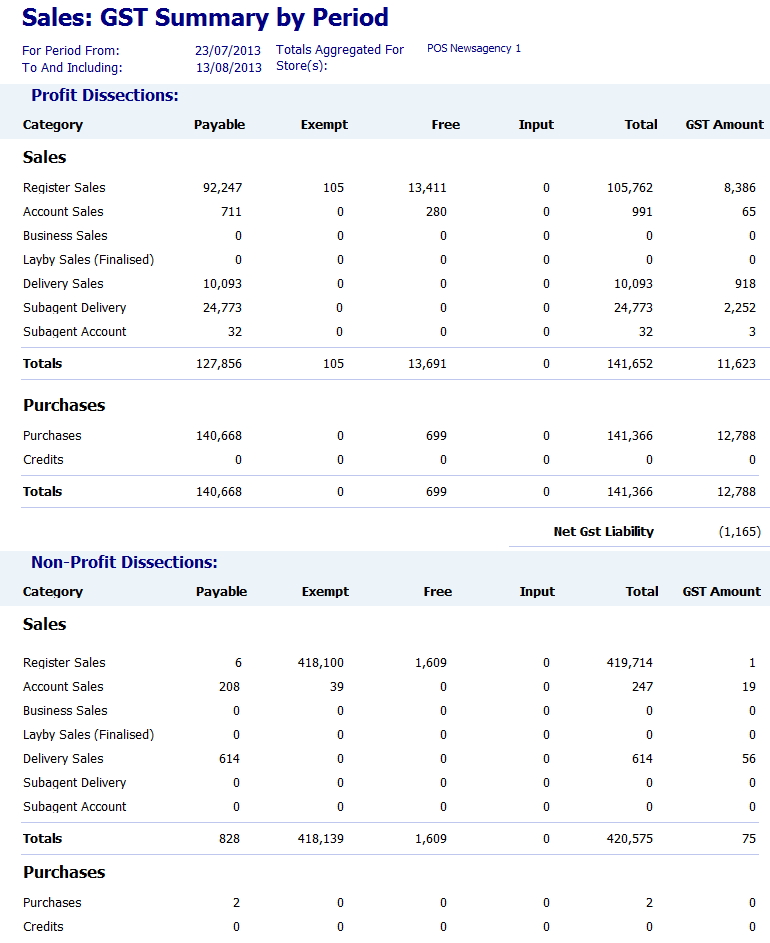 Source:- https://www.possolutions.com.au/blog/how-to-check-my-gst-in-detail
Introduction to GST (Goods and Services Tax)
Goods and Services Tax (GST) is a multi-stage, destination-oriented tax system that is imposed on every value addition. It replaces the indirect tax system which includes excise duty, VAT, service taxes etc. GST creates a uniform and transparent tax structure. GST revolves around the principle of charging the tax based on value addition at each stage of the supply chain. GST integrates goods and services into a single tax structure. Through this integration, it helps in reducing the rolling effects of taxes which are used to increase the prices of goods and services. GST avoids a double taxation system. It adds tax only at the value added at each stage. This helps in reducing the total tax burden. GST is also considered a destination-based tax system. As here the tax revenue is collected at the consumption location instead of the production place. Due to this the revenue that is generated from GST is circulated among the consuming states. GST has been structured into multiple slabs according to the diversified nature of goods and services. As per this multi-slab structure, a low tax is levied on essential items and a higher tax is applied on luxury items. The GST can be applied properly by proper collaboration between the central and state governments. Central GST (CGST) is administered by the central government and State GST (SGST) is taken care of by the state government. In addition to this central government levies and collects Integrated GST (IGST) Also Read: GST: Everything You Need To KnowUnderstanding the Basics of GST Summary
GST summary is a comprehensive record which provides a brief of your tax and liabilities. It includes the details of sales, purchases, and tax payments thereby offering a clear overview of financial transactions taking place in a specified period. Let’s get into understanding GST summary and its basics.-
Essence of GST
-
Destination-Consumption-based tax system
-
The Multi-Slab Structure
-
Dual GST system
-
Technology Integration
Why Obtaining a GST Summary is Essential?
The GST system has brought transparency to the taxation system. For businesses and individuals, knowledge about the GST summary is a necessity in today’s world. Here are some reasons why GST summary is so essential: –-
Clarity in Tax Structure
-
Optimizing Tax Planning
-
Facilitates Compliance and Filing
-
Claiming Input Tax Credits
-
Adaptation to the Regulatory Changes
Different Ways to Access a GST Summary
There are different ways for accessing GST summary as per the taxpayer’s requirement. Here is the brief of each way to obtain a GST summary: – GST Summary Access example:-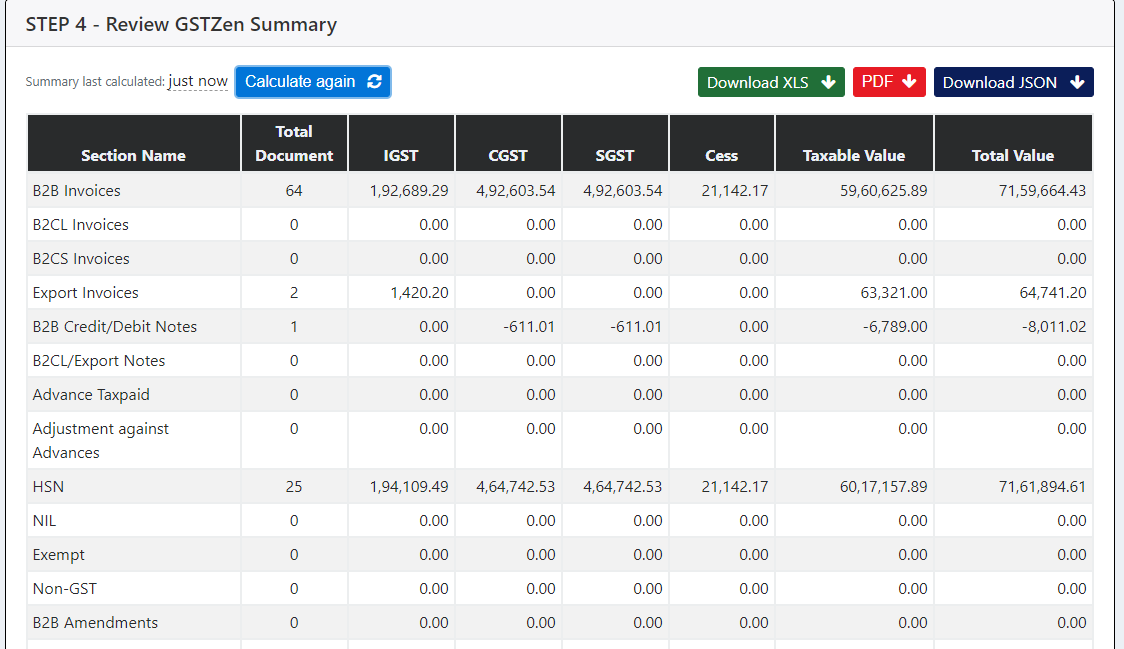 Source:- https://www.gstzen.in/a/filing-monthly-outward-supply-return-gstr-1.html
-
Government Portals and Websites
-
GST Network Portal
-
GST Software Solutions
-
Professional Services
Interpreting a GST Summary Effectively
GST has contributed a lot to modern-day taxation. Businesses need to have a proper understanding of the GST summary. This will help them to take advantage it. Here are key aspects of how GST summary interpretation can be done: –-
Understanding the Basics
-
Decoding Input Tax Credit
-
Analysing Output Tax Liability
-
Net Tax Payable and Settlement
-
Compliance with GST Rules and Regulations
Importance of GST Summaries for Different Entities
GST summaries provide valuable insights into financial health, compliance and decision-making. Let’s understand the GST summary importance for different entities.-
Small and Medium Enterprise (SMEs)
-
Large Corporations
-
Individual taxpayers
-
Government Authorities
-
Financial Institutions
Conclusion
Obtaining a GST summary is very important for individuals and businesses. GST summaries can ensure compliance, audit readiness and strategic financial planning. The process of getting a GST summary has some key steps. This will benefit the GST framework. Businesses need to maintain proper financial records. Proper bookkeeping practices will serve as the foundation of a comprehensive GST summary. Businesses shall also implement accounting software to track GST liabilities and credits. This will smoothen the process of GST summaries. Regular reconciliation of financial data with GST returns will help in getting an accurate GST summary. By observing best practices in businesses and integrating technology, entities will be able to get accurate GST summaries. Also Read: Know Everything About GST Billing SoftwareFrequently Asked Questions
-
How do I obtain my GST summary?
-
How to reconcile the GST summary with business accounts?
-
Is there any restriction on the download of the GST summary?
-
Is it possible to get a GST summary online?
-
What is the difference between a GST summary and a GST return?
-
Can I request a GST summary for multiple businesses?
-
How do I download the GST summary?
-
What information mentioned in the GST summary is confidential?
-
Is it possible to get a GST summary of previous years?
-
Can I download the GST summary in a different format?