
Introduction
Goods and Services Tax (GST) simplifies the tax system when buying goods or services. It replaces confusing old taxes, making it clearer and preventing evasion. It impacts the cost of items by adding a bit of tax at each stage. Businesses benefit by claiming Input Tax Credit (ITC), avoiding double taxation. They must register for GST if sales cross the threshold value, getting a unique number for all GST-related activities. Understanding the GST registration process, compliance guidelines, ITC, implications for small businesses, and filing deadlines is crucial for smooth operations.Understanding the Basics of GST
GST, or Goods and Services Tax, is a kind of tax that’s applied when you buy things. It’s a bit different from the old tax system we had before. Instead of having lots of different taxes like sales tax and service tax, GST combines them into one. Now, there are three types of GST. The first one is CGST, which is like a tax collected by the central government. The CGST part of GST goes to the central government. Then there’s SGST, which is a tax collected by the state government. The SGST part of GST goes to your state government. And finally, there’s IGST, which is a tax for goods and services that move between different states. Example: Let’s say you buy a shirt in your own state for $100. If the GST rate is 10%, you pay $5 as CGST and $5 as SGST. So, the total GST is $10. Now, if you buy the same shirt from a different state, you pay IGST, let’s say $10. The total $10 goes to the central government, and then it’s divided between the central and state governments. So, if you buy something within your own state, you pay CGST and SGST. But if you buy something from another state, you pay IGST.Business Implications of GST
 There are different business implications such as:
- Pricing:
- Effect on Business: Changes in how businesses set prices for their goods or services.
- Explanation: GST simplifies taxes, aiming for clearer pricing. Businesses may require time to adjust their pricing strategies under this new system.
- Supply Chain:
- Effect on Business: Impact on the process of obtaining raw materials, manufacturing products, and selling them.
- Explanation: GST facilitates smoother movement of goods between states, potentially saving time and money in transportation. However, businesses may need to reorganize their supply chain processes.
- Overall Operations:
- Effect on Business: Potential changes in day-to-day operations.
- Explanation: GST introduces a simplified tax structure, reducing paperwork and aiming for smoother operations in the long term. However, businesses may face an adaptation period to comply with the new rules.
Here are the positive and negative implications of GST in business:
| Positive Implications of GST | Negative Implications of GST |
| 1. Simplified Tax Structure: GST replaces multiple indirect taxes with a single tax, simplifying the overall tax structure. | 1. Initial Implementation Challenges: The transition to GST might involve initial challenges, including adapting to new compliance requirements and technology. |
| 2. Removal of Cascading Effect: GST eliminates the cascading effect of taxes, as businesses can claim input tax credits on the tax paid for inputs. | 2. Compliance Burden: Businesses may find the compliance requirements under GST to be more extensive, requiring regular filing of returns and adherence to specific procedures. |
| 3. Improved Logistics and Efficiency: The uniform tax structure reduces checkpoints and facilitates smoother movement of goods across states, improving logistics and overall business efficiency. | 4. Fluctuations in Tax Rates: GST rates can be subject to changes by the government, leading to uncertainties and potential adjustments in pricing strategies for businesses. |
| 5. Nationwide Market Access: GST creates a unified national market, enabling businesses to access a broader customer base without facing state-specific tax complexities. | 5. Impact on Cash Flow: Businesses might experience temporary disruptions in cash flow due to the requirement of upfront payment of taxes and subsequent refund claims. |
GST Compliance and Filing
GST compliance means following government rules about GST, providing needed info and docs. This ensures businesses follow tax laws, pay the right tax, and keeps the tax system fair. Complying is vital to avoid penalties and legal issues, ensuring a smooth tax system. Here’s a step-by-step guide to filing GST returns and meeting compliance requirements.- Registration:
- Data Collection:
- Invoice Preparation:
- Calculation:
- Filing Returns:
- Verification:
- Payment:
- Acknowledgment:
- Reconciliation:
- Compliance Check:
- Record Keeping:
- Audit (if applicable):
- Timely Filing:
GST and Business Transactions
Business transactions are when companies buy and sell goods or services to run their business. GST impacts these transactions. When businesses sell, they add a bit of tax to the price, which the customer pays. The business later gives this tax to the government. When businesses buy, they pay tax on their purchases, creating a credit. This credit offsets the tax they collected from sales, reducing overall tax. For interstate trade, there’s a special GST called IGST, simplifying tax for transactions between states.GST Input Tax Credit (ITC)
GST Input Tax Credit (ITC) is like a discount for businesses, helping them avoid paying tax twice on the same things they buy. It’s crucial because it reduces overall tax, making businesses more competitive. Benefits include lower operational costs, reducing input expenses, and improved cash flow as businesses can use ITC to offset tax, managing money better. Also read: INPUT TAX CREDIT UNDER GST Example – Purchase of Raw Materials: A manufacturer buys raw materials for $1,000 with a GST of $180. When the manufacturer sells the finished product for $2,000 with a GST of $360, they can offset the $180 GST paid on raw materials against the $360 collected on sales.Compliance Challenges and Solutions
Here are the compliances challenges and it’s solutions| Compliance Challenges | Solutions |
| 1. Complex Filing Process: | 1. Simplified Guidance: Provide businesses with straightforward instructions and guidance to simplify the filing process. |
| 2. Timely Filing of Returns: | 2. Automation Tools: Implement automated systems or tools to streamline the process and ensure timely filing of returns. |
| 3. Understanding Tax Codes: | 3. Training Sessions: Conduct training sessions for businesses to enhance their understanding of tax codes and classifications. |
| 5. IT System Integration: | 5. Seamless IT Integration: Facilitate seamless integration of IT systems to minimize disruptions and ensure accurate reporting. |
| 6. Keeping Abreast of Regulatory Changes: | 6. Regulatory Updates: Provide businesses with timely updates on regulatory changes to keep them informed and compliant. |
| 7. Handling Tax Notices and Audits: | 7. Proactive Compliance Measures: Encourage businesses to adopt proactive compliance measures to minimize the risk of tax notices and audits. |
Impact of GST on Various Industries
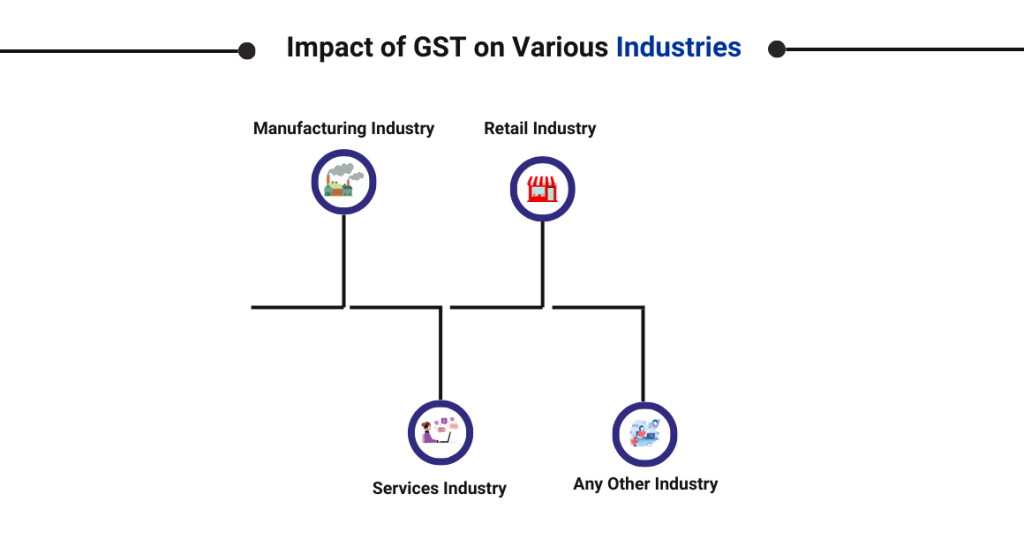
- Manufacturing Industry:
- Impact: Buying raw materials and selling finished products became a bit simpler.
- Example: If a factory buys steel to make cars, they now only pay tax on the profit they make when selling the cars.
- Services Industry:
- Impact: Service providers now need to pay GST, but they can also claim back tax on things they use for their services.
- Example: If a consultant buys a computer to work, they can get back the tax they paid on that computer.
- Retail Industry:
- Impact: Selling products involves adding a bit of tax, but businesses can also get back the tax they paid on the products they bought.
- Example: If a shop sells a TV, they add a bit of tax. But if they bought the TV from a manufacturer, they can get back the tax they paid on it.
- Any Other Industry:
- Impact: Different industries might see changes, but the idea is to simplify taxes.
- Example: In the healthcare industry, if a hospital buys medical equipment, they pay tax, but when they provide medical services, they add a bit of tax.
Future of GST and Business
In the future, the government could make changes to how GST operates, introducing new rules or rates that impact how businesses deal with taxes. To prepare for upcoming changes, businesses should stay informed about any introduced modifications. If changes occur, businesses need to adjust their processes accordingly to meet new requirements. Staying aware of government adjustments is crucial for businesses to understand what might come their way. Being ready to adapt to changes in how they handle GST, whether in pricing, operations, or compliance, is essential. Looking ahead, businesses must stay flexible and ready to change their approach to GST if needed, ensuring they stay on top of any updates that may arise.Conclusion
To sum it up, understanding how GST affects businesses is crucial. We’ve covered the basics and shared examples to show its impact. Looking ahead, businesses should stay alert for any changes in GST rules. Being flexible and adapting to new things will help them succeed in this ever-changing tax system. The journey under GST continues, and businesses, with knowledge and flexibility, are ready to do well in the evolving tax scenario.FAQ’S
-
What is GST, and why was it introduced?
-
How does GST differ from the previous tax system?
-
What are the key components of GST, such as CGST, SGST, and IGST?
-
Why is GST important for businesses, and how does it impact pricing?
-
Can you explain the process of registering a business for GST?
-
What is Input Tax Credit (ITC), and how does it benefit businesses?
-
How does GST influence various business transactions, including sales and purchases?
-
What are the compliance requirements for filing GST returns, and why is compliance important?
-
What are some common challenges businesses face in complying with GST, and how can they be addressed?
-
How has GST affected specific industries, such as manufacturing, services, and retail?